



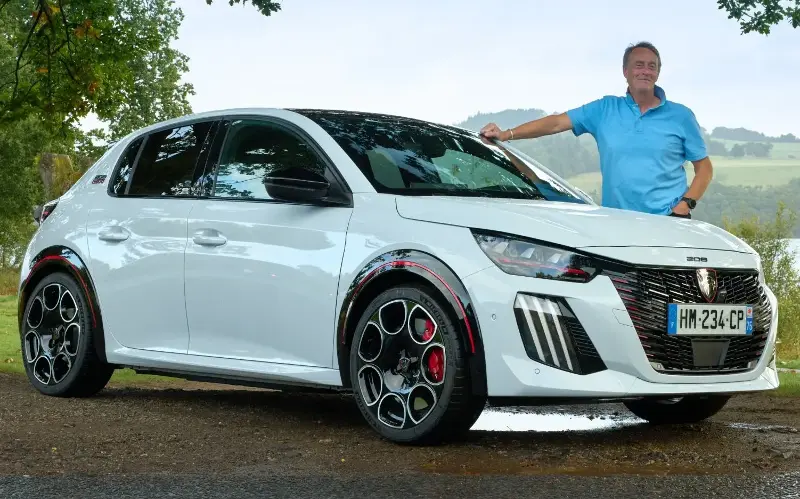
Britain loves a hot hatchback, so excitement has been mounting since Peugeot announced a high-performance version of its E-208 electric supermini wearing GTi badges, recalling the distinctively French, lithe-and-lovely 205 GTi of 1984. That seminal car had 105bhp from a four-cylinder petrol engine to power 850kg. The French concern’s battery-powered equivalent has 277bhp propelling 1,610kg.
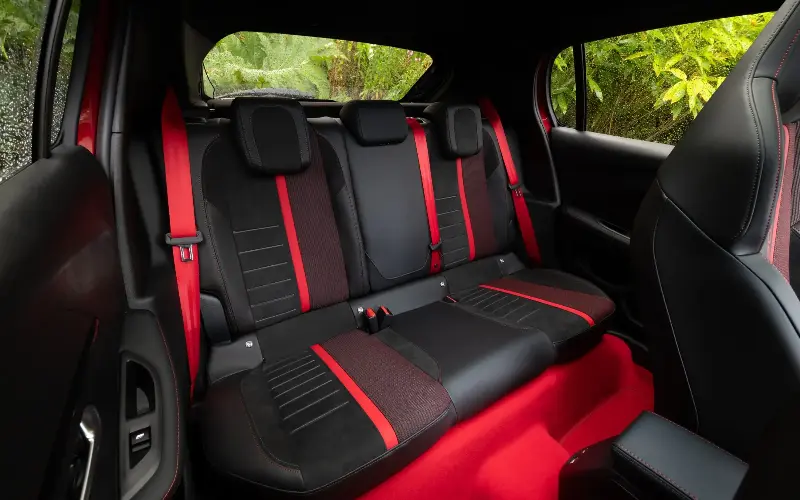
Naturally there’s the whole panoply of GTi cues, not least lashings of scarlet trim to go with the racing-style bucket seats, drilled pedals, a perforated leather steering wheel rim and uprated instrumentation.
The high-performance formula is bolstered by 18in punched alloy wheels with grippy Michelin Sport Pilot tyres, lowered and titivated suspension, with hydraulic bump stops and increased anti-roll effect at the rear, along with a Torsen limited-slip differential to rein in wheelspin.
I quite liked the style, which recalls the original without resorting to pastiche, while the 208 is the best looking of the myriad Stellantis models based on its CMP platform. And while the E-208 GTi badging is a little de trop in places, the whole package passes muster, especially in the white of our test car.
Weighty concerns
Excited yet? Non? Perhaps that’s because you’ve calculated the power-to-weight ratio for the E-208 GTi, which is 172bhp/tonne compared with the 124bhp/tonne of the original of 42 years ago. That’s just over a one unit gain per year, less exciting, more underwhelming, you might think.
In the credit column, the E-208 GTi produces zero tailpipe emissions although the electricity used to charge it has an environmental cost, while it’s substantially safer in a crash than its forebear. It’s larger inside (although not by very much) and unlike the somewhat flimsy-feeling original the steering column doesn’t flex over bumps. And, being powered by batteries, you don’t need to rev it to the maximum to make decent progress.
In fact the top speed of 111mph and 0-62mph acceleration in 5.5 seconds makes it quite handy against the earlier car’s 121mph and 8.6 seconds. But the real question is how far you can drive it like that, as range is this car’s Achilles’ heel, with a claimed WLTP Combined figure of 218 miles. Driven gently, the 205 GTi would achieve more than 400 miles from its 50-litre petrol tank.
The Scottish launch route, on some of the most speed-camera-enforced roads in the UK, yielded an efficiency of 3.1m/kWh, which equates to a range of 158 miles from a full charge. Even given the standard heat pump, frost, steep hills or spirited driving will murder the range.
Raison d’être
So why is Peugeot trying to relive its past glories with a battery GTi which, because of the 340kg weight of the 54kWh gross lithium-ion battery, is always going to be a different proposition to drive with a disparate set of compromises?
The answer is the Chinese competition in this mini and supermini segment, which is starting to make its presence felt, undercutting European manufacturers with lower production costs, helped by government subsidies which are banned in Europe and downright predatory pricing strategies to buy market share. This used to be the strategy employed by Japanese and then Korean manufacturers.
At present, Chinese car makers don’t have a clue about the sort of fine chassis dynamics which Europeans are (occasionally) brilliant at achieving, their design departments lack flair and their cars are boring to drive. What Peugeot is doing with this car is far from simply raiding its back catalogue. Like Renault with its R5 and Alpine models, the French are saying: this is what only we can do, this is rewarding to drive, this brings a smile to your face, this is fun!
On the road
Is it, though? With MacPherson-strut front and a twist-beam rear suspension, the underpinnings are based on the regular E-208, which is right and proper to keep costs down but contains its own set of compromises of ride versus handling. Add in the 215/40/R18 tyres and the ride is fairly noisy and abrupt over anything with a sharp edge, although at speed the body control is terrific and confidence-inspiring.
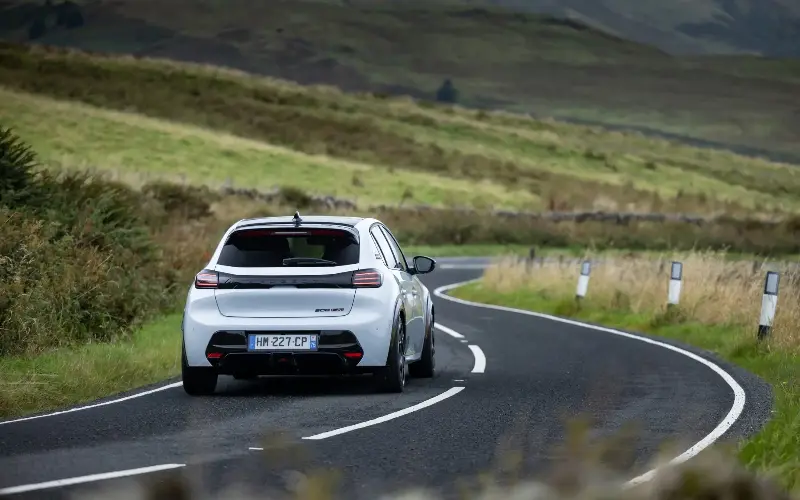
The performance was scintillating and strong from low speeds, as you’d expect from an electric drivetrain, although after only 100 miles the systems were dialling back the performance to preserve the range. There are three driving modes – eco, normal and performance – so the set-up is simple and logical, while there’s also a turbine-like fake noise which is broadcast on the stereo speakers (which you can switch off).
The sum of its parts make this a terrific performance hatchback, although the limited range restricts its abilities. Drive fast and you’re always thinking of where you’ll be able to recharge, especially in Scotland, where charging points can be far-flung.
The steering is very good, though. Even when it rained knives and forks, I could feel the front into a corner, although Peugeot’s i-cockpit set-up (with a small steering wheel which sits in your lap) is a very acquired taste. The grip, meanwhile, is phenomenal and traction via the limited-slip differential is uncanny. The brakes are strong enough but the pedal feels soft at the top of its travel.
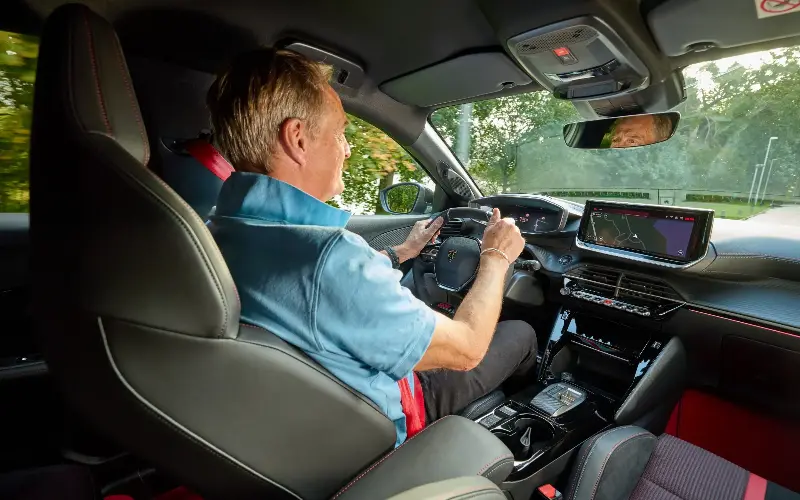
Strangely there aren’t any paddles behind the rim to adjust the level of regenerative braking so only the screen-adjustable settings are available, or you can use the B mode to increase the intensity of slowing when you lift off the accelerator to help balance the nose into a turn, which turns off in Sport mode.
The Telegraph verdict
There are dilemmas involved in building hot small-battery cars and the E-208 crunches firmly against a few of them: range versus battery size, agility versus weight, cost versus affordability. Petrol-powered performance hatchbacks such as the original 205 GTi danced over that tightrope, I’m not sure its 21st-century EV successor manages so adroitly.
It’s good looking and handles brilliantly, but the poor range hits you twice, first in restricting the distance you can travel and second in the time you’ll spend cramming in as much energy as possible.
“It’s our own vision of the future,” says Agnes Tesson Faget, the E-208 GTi project manager, “it’s futuristic and pleasurable, but in the world we live in, it’s a different car.”
So perhaps we need to redefine what the revered GTi letters mean on any car with pretensions of thrilling performance and driving pleasure: still fast and fun, but only in small doses…
The facts
On test: Peugeot E-208 GTi
Body style: five-door supermini
On sale: November 2026
How much? from £34,995 (£33,495 with Government grant)
How fast? 111mph, 0-62mph in 5.5sec
How efficient? from 3.63 miles/kWh (3.1 m/kWh on test)
Powertrain: 54kWh gross, 51kWh useable lithium-iron phosphate battery, AC synchronous permanent-magnet motor with step-down gearing, front-wheel drive
Range: 218 miles (WLTP Combined), 158 miles on test
Charging: 20-80 per cent in 30min on 100kW DC charger, 0-100 per cent in 6hr 50min on 7.4kW household wallbox
Maximum power/torque: 277bhp/254lb ft
CO2 emissions: 0g/km (tailpipe), 18.8g/km (CO2 equivalent well-to-wheel)
VED: £10 first year, then £200
Warranty: three years/60,000 miles, eight years/100,000 miles on battery
The rivals
Alpine A290
from £33,500-£38,500
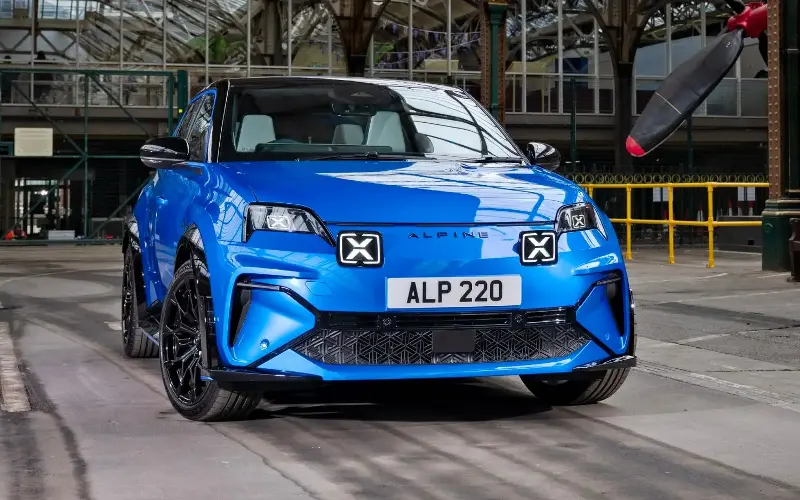
Lovely hot hatchback based on Renault’s R5. Well-judged go-faster styling is matched by the fundamentals for driving enjoyment, although the 236-mile range limits its appeal.
Alfa Romeo Junior Veloce
from £42,300
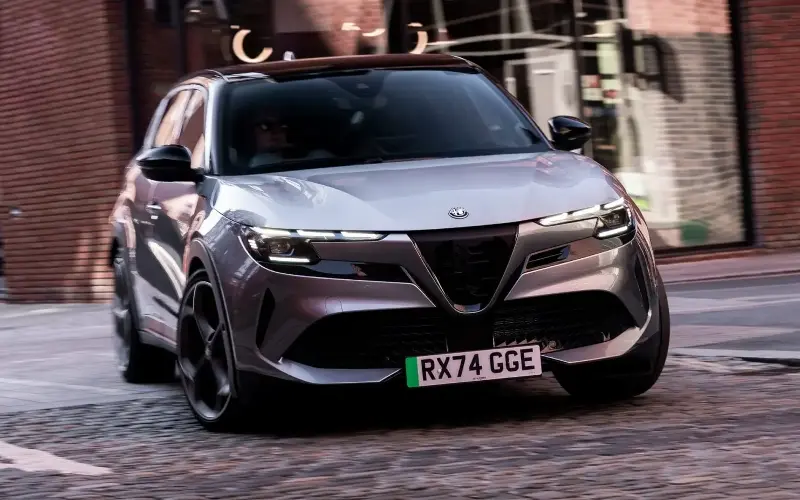
Residual values for this sporty version of Alfa’s EV crossover aren’t great, although the driving experience is terrific. With a similar drivetrain to the E-208 GTi, performance (and range) are comparable.