



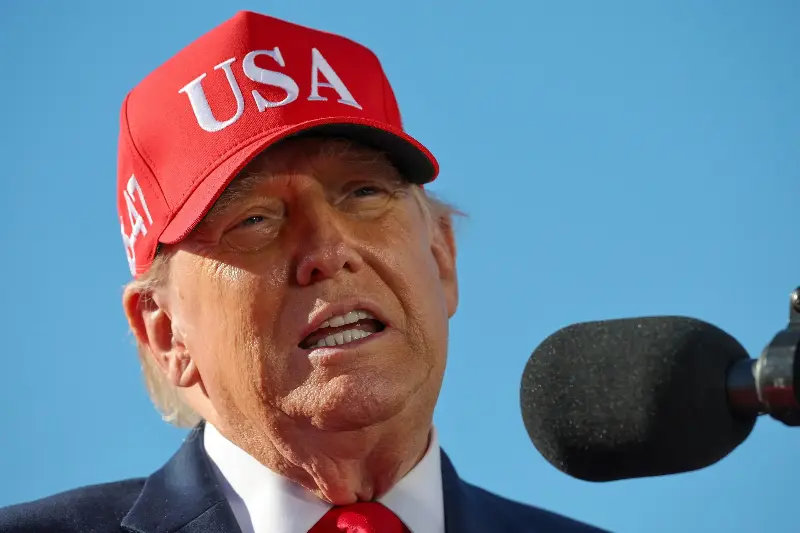
Donald Trump has said that oil flows have returned to their levels from before the Iran conflict, though the figures obscure important realities about global energy recovery from a seven-month war shock.
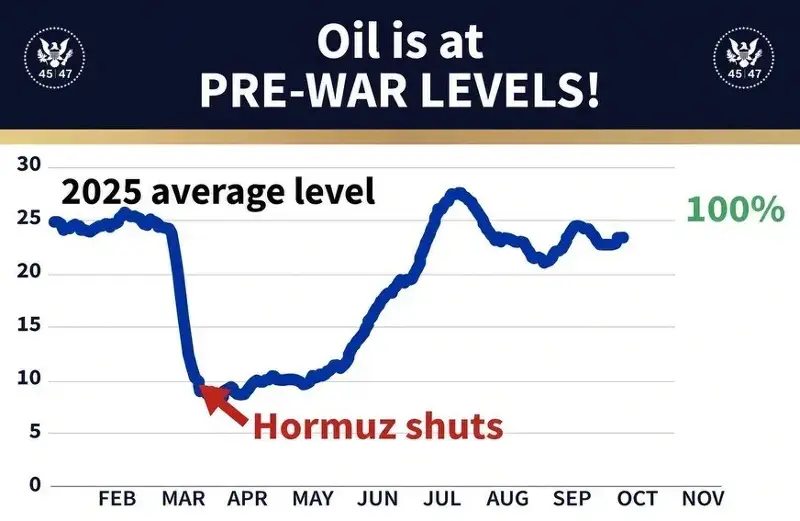
On Wednesday evening, the president shared a chart which declared that oil is “at PRE-WAR LEVELS!” Neither the chart nor Trump’s post revealed what the chart was showing specifically, though it showed the figures sinking in late February—in line with the beginning of the war—and bouncing back in summer to what is described as the “2025 average level.”
When approached for comment, a White House official confirmed that the chart was displaying the “volume of oil transiting through” the Hormuz Strait.
“President Trump is right—the volume of oil transiting through the Strait has approached preconflict levels,” the official said. “Thanks to the historically successful blockade, nothing gets through to Iran, but the Strait is open for everyone else.”
Is Oil at ‘Pre-War Levels’?
The chart featuring the “45/47” logo occasionally used by the White House and Trump’s political campaigns, though it has not yet appeared in any official publications and did not state the basis on which oil had returned to “pre-war levels.”
Prices for oil and gas increased sharply following the U.S.-Israeli strikes on February 28, which kicked off the conflict and Iran’s closure of the Hormuz Strait, and remain significantly higher than before this date. The chart falls in late February, however, implying that the Y-axis is a supply-related measure.
And the trend broadly mirrors oil flows out of the Middle East, which analysts say have recovered in recent weeks thanks to a combination of U.S. military escorts for tankers, novel shipping methods out of the Gulf region and the increased use of pipelines to bypass the Hormuz Strait.
Around 20 million barrels of oil went through the waterway each day before the conflict, accounting for around a quarter of global supply, though traffic slowed to a near standstill shortly after amid Iranian threats against U.S., Israeli and allied ships.
Recent research from Kpler, however, found that crude exports have now largely recovered. The maritime intelligence platform said: “At least 16.5 [million barrels per day] left the region in September, matching the pre-war average excluding Iran.”
Kpler tracks bypass routes by combining vessel-tracking data, port activity, cargo movements, and proprietary analytics to identify and validate changes in maritime trade flows.
Kpler noted that 40 percent of exports from the Gulf now bypass the Hormuz Strait, compared to only 17 percent before the war, with Saudi Arabia and the United Arab Emirates providing critical, alternative land-based routes.
The Harvard economist Willy C. Shih agreed that the Y-axis on Trump’s chart “appears to be millions of barrels per day moving through the Strait of Hormuz,” and told Newsweek that in this regard Trump “has a fair point that the problem is refining capacity, not crude oil flows out of the Persian Gulf.”
“Tens of millions of barrels of oil are transiting the Strait on a daily basis, with over 2,000 commercial ships and 1 billion barrels of oil escorted through so far,” a White House official told Newsweek.
When Will Prices Come Down?
According to AAA, the nationwide average price for gas stood at $4.36 per gallon as of Thursday, up from $3.12 a year ago. Diesel has climbed down from its record high of $6.53 in September, but has still risen around 70 percent to $6.28 in the past 12 months.
Tom Kloza, chief energy adviser at Gulf Oil, said that lingering effects of the war are likely to keep fuel elevated even if oil transits mounted a sustained recovery.
“Oil may be flowing out of the Middle East at a reasonable rate, but the expenses tied to moving it from point a to point b are not reasonable,” he told Newsweek. “The cost of insurance and typical freight have moved parabolically higher.”
But rather than any factors directly tied to the Iran war—such as Middle Eastern oil flows—Trump has recently taken to blaming a lack of refining capacity for ongoing tightness in global fuel supplies. More specifically, the president has criticized Democrat states for closing refineries, urged Ukraine against further attacks on Russian refineries, and argued that these are now the primary reasons for elevated gas and diesel prices in the U.S.
Safe embed will be rendered here
Iran war diesel
Service URL: https://public.flourish.studio/visualisation/30362727/embed
“What’s driving up Gasoline is no longer the Strait of Hormuz, because Record Numbers of Barrels are coming out now on an almost daily basis, but the word, ‘Refineries,’ where Russia‘s are being blown up by Ukraine, and where ours are being closed up, in Blue States, like California, by the Dumocrats,” Trump posted to Truth Social on Monday.
Safe embed will be rendered here
diesel vs iran and ukraine
Service URL: https://public.flourish.studio/visualisation/30352330/embed
However, spikes have coincided closely with developments in the war, and Shih told Newsweek that, when it comes to diesel, Russia representing only 6.8 percent of global refining capacity means significant blame cannot be placed on Ukraine who are “only trying to stop Russia’s war machine after all.”
“Russian capacity removed from the global market will certainly tighten supplies of this globally trade commodity, but the Iran war generally speaking had a bigger disruptive effect, in my opinion,” he said.
Oil prices—which likewise remain elevated despite the recovery in flows—have also spiked this week on the back of talk regarding another escalation in the conflict. Based on discussions with several administration officials, The Atlantic reported that the president was weighing further strikes against the country ahead of the midterm elections on November 3.
“The U.S. is in a very strong position with control of the Strait of Hormuz and the Iranian economy collapsing. Iran has been decimated, and things will go one of two ways: the easy way or the hard way,” a White House official told Axios. “President Trump holds all the cards and will do whatever is best for the United States.”
Want access to the latest insights on politics and economics? Sign up here to follow the money with Hugh Cameron and Newsweek’s Accountable Newsletter each week, from the fiscal debates dominating Washington to the real-world impact on your wallet.
Newsweek’s reporters and editors used Martyn, our AI assistant, to produce this story. Learn more about Martyn here.
Contact Newsweek editors on this story: Matthew Robinson and James Debens