



When Z Cher-Aimé created Captain Zero in 2015, they were 18, newly in college, and still learning to describe an experience many around them couldn’t see.
A year earlier, they had been diagnosed with major depressive disorder. During a severe episode, they began imagining a window into the mind of a Black teenager whose inner life carried the stakes of a superhero battle.
“I wanted so badly to be understood because I felt so voiceless and so powerless,” Cher-Aimé told Newsweek. “I wish I could kind of create a window into the mind of someone who was dealing with mental health issues.”
The idea grew from intimate experience, while its visual language drew from anime and the Western animated series Cher-Aimé loved—Dragon Ball Z, Spider-Man: The Animated Series, Batman: The Animated Series, X-Men, Justice League and, most crucially, Static Shock.
“I remember waiting years and years for there to be something” after Static Shock ended, they said. “There’s nothing to replace this.”
Soon after, Cher-Aimé met Andre Engco in a college writing class, and an initial flash of competition turned into a partnership. Cher-Aimé remembers hearing Engco’s writing sample and thinking, “Hold on, wait a minute. I think there might be a little competition in this class.”
That thought sparked a partnership built on mutual respect, which went on to form Cutting Edge Animation.
“Individually, we’re both really good filmmakers and really good storytellers, and if we work together, we could be one great storyteller,” Cher-Aimé said.
Finding the Drama Behind the Mask
Cher-Aimé had envisioned a contemporary successor to Static Shock, while Engco brought a taste for The Wire, Breaking Bad and The Sopranos. Their fusion sharpened the premise: Xerxes Hughes, a teen hero living in New Troy City, recounts his crises in therapy while his depression assumes a physical form.
“What if this was like The Wire?” Cher-Aimé recalled Engco asking. “What if this was HBO-level drama? What if it’s about his depression? What if we frame it through his therapy sessions?”
The model became Spider-Man 2, which Cher-Aimé calls “a character drama that happens to have superheroes in it.” Engco’s perspective broadened the project, though the collaborators kept a grounded focus on Black life, family expectations, social pressure and the private cost of public heroism.
“What makes Spider-Man so fascinating,” Cher-Aimé said, “is the tango, the balance of trying to balance these two things.” For Captain Zero, therapy creates access to the person behind the costume. “The superhero stuff is cool,” they added. “It’s the person behind the mask who’s so fascinating.”
Engco saw the advantage of joining forces early. “We had the foresight to put our energies together and build something instead of trying to take each other down at every corner,” he said.
Their method still carries a playful tension: Engco asks, “What if?” and pushes toward chaos, while Cher-Aimé pulls the idea toward structure.
“That’s how we find this perfect middle,” Engco said.
Why 2D Animation Still Matters
In an increasingly AI-focused age, both filmmakers leaned into a traditional approach. For the duo, hand-drawn 2D animation carries a familiar memory and texture. The look recalls Saturday-morning cartoons and 1990s anime, but the storytelling leans toward adult prestige drama, where violence, therapy, and moral compromise can coexist in the same frame.
“We always felt it was important to keep that 2D animated style,” Engco said. “We don’t get HBO-level dramas that are 2D animated. It’s refreshing to see drama animated in 2D.”
Cher-Aimé wanted viewers to approach the material with the same seriousness they would give live action.
“There is violence. There are real things happening,” they said. “Everything happening is so serious, and you’re meant to take it very seriously in the same way you would any of those live-action prestige dramas.”
The short films became a proof of concept because festival limits forced the team to compress its world into roughly 15 minutes. The feature will expand Xerxes’ school life, home life, friendships and relationship with his mother, while answering the cliffhanger posed by Into the Abyss Part II.
“We want people to get a glimpse of what Hyper-Humans are and what New Troy City is like, and then leave a lot of open-ended questions,” Cher-Aimé said. “The direct continuation is the feature film, where we get to really delve deep into his personal life.”
A Cast Drawn to the Story
The project’s growth has often depended on an unlikely chain of introductions. Cher-Aimé reached out to Angelica Ross after drawing a character with her voice in mind; she responded, asked for materials and helped move the project toward representation. When an agent heard Cher-Aimé’s temporary performance as Xerxes, the placeholder became a role.
Acclaimed actor Keith David soon signed on as the Depression Demon, while Emmy, Grammy, Oscar, and Tony Award winner Whoopi Goldberg joined as an executive producer after the project’s successful Tribeca premiere; Christopher Judge of God of War fame and Gary LeRoi Gray later joined the expanding ensemble. The film’s announced voice cast also includes Angelica Ross, Larenz Tate, Zolee Griggs and Nandi Nfr Ka, with Goldberg serving as an executive producer.
“Every single connection we’ve made from this project has been so organic because the pull for every single person is the story,” Cher-Aimé said. Hearing people they had admired praise their writing felt surreal. “I’m listening to Spawn tell me he’s impressed with my work.”
Engco called the response “very validating,” while Cher-Aimé described it as confirmation arriving before the finish line.
“You spend those late nights and those long hours,” they said, “and you wake up, look at it the next day and think, ‘This is terrible.’”
Each new collaborator offered another vote of confidence in the underlying story.
Making the Internet Into a Monster
Turning the planned series into a feature required old ideas to assume greater weight. W.Z.R.D., once a smaller villain, became Xerxes’ chief adversary—a digital nihilist who weaponizes public attention, online cruelty and a hero’s need for approval.
“Wizard has essentially become Xerxes’ Green Goblin,” Engco said. Social media had always played a central role in the story, Cher-Aimé explained, because Xerxes “uses social media to crowdsource his self-esteem,” and millions of opinions can affect his depression, which then alters his powers.
The filmmakers were already writing about social platforms in 2015, although the culture’s accelerating hostility gave W.Z.R.D new contours. During one writing session, Kendrick Lamar’s “Meet the Grahams” arrived amid his feud with Drake, and the collaborators paused to listen before returning to the script with fresh energy.
“W.Z.R.D is a supreme hater,” Cher-Aimé said. “He hates everything about what Xerxes is, what Captain Zero represents and what he means.” The villain’s power rests in patience: “You think this was going one way—no, man, I’m 10 steps ahead of you. I planned this already.”
Engco said the character pulls “the worst side of the internet” from comment sections and online forums, then makes it “physical” and “very scary and dark.” Gary LeRoi Gray’s early performance helped the writers reshape later acts, while the movie’s expanded canvas allowed horror to enter the project more fully.
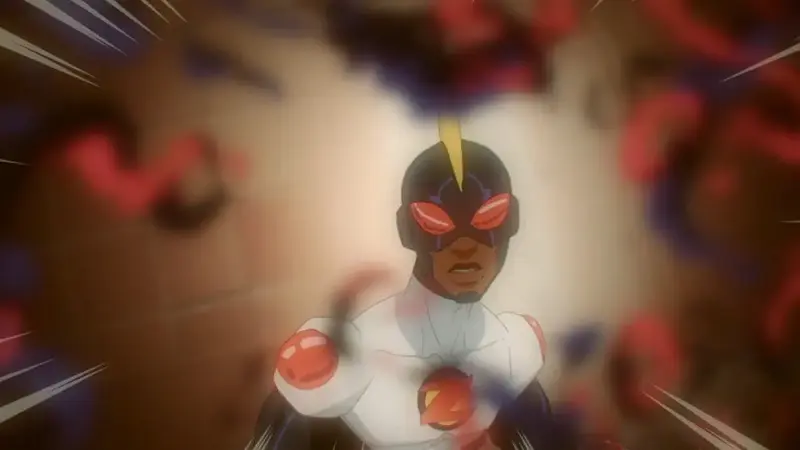
When a Personal World Starts to Burn
The tonal mixture—superhero action, neo-noir, psychological drama and horror—works because each mode remains tied to Xerxes’ perspective. Depression can be frightening, social embarrassment can be funny, and a fight can expose emotional stakes, while the characters treat each experience as real.
“I think it’s more interesting if your world is going to blow up,” Cher-Aimé said. “The world could be on fire, and it’s a different thing when your personal world is on fire.”
They described an “existential horror” in knowing life continues while one person’s reality feels close to collapse.
Ryan Coogler’s Sinners offered a recent model for such control, Cher-Aimé said, because its action, period detail, horror and music remain grounded in character. “Each scene is living and breathing with authenticity,” they said.
For the pair, it sparked a revelation: let every scene convey its own truth, and trust the emotional spine to hold the genres together.
Engco believes audiences already understand superhero grammar, which gives the filmmakers room to bend it.
“This isn’t going to be the first superhero movie the audience ever sees,” he said. “Our inclusions of horror, neo-noir and the anime influence will add a refreshing take.”
Fail, Get Up, Try Again
Cher-Aimé traces the story’s emotional engine to an idea common in Shonen anime like Naruto and One Piece: fail nine times, get up 10. Xerxes misreads situations, withholds the truth in therapy, and makes choices his creators recognize from their own lives, yet his flaws point the way to change.
“Every great story has a message, an idea,” Cher-Aimé said. “If you’re dealing with this problem, this is how you get through it.”
Xerxes must become honest and vulnerable, confront his darkest parts and accept his flaws. “That ultimately really is his biggest superpower,” they said.
Engco recognizes himself in the hero’s mistakes.
“I know we’re writing something that doesn’t paint Xerxes in the most beautiful light,” he said, “and I’m sitting there writing, ‘I’ve made that mistake.’”
The identification runs “for better and for worse,” which makes the character feel immediate rather than emblematic.
Eleven Years in the Same Boat
After more than a decade, the collaborators describe making Captain Zero through a maritime metaphor. They began on a beach with scraps of wood, convinced treasure waited across an ocean, although neither knew how to build a boat. Over time, collaborators, financing and hard-won craft turned the raft into something seaworthy.
“There have been plenty of moments where it’s been hard and difficult,” Cher-Aimé said. When one writer’s arms gave out, the other kept paddling. Cher-Aimé remembered pushing a broken-down car with Engco and feeling their combined effort finally move it.
“If I did this by myself, this would feel absolutely impossible,” they said. “With you next to me, you just being here gave me the energy.”
Engco returned the sentiment. “We’ve grown so much as friends and as writing partners,” he said. “I don’t know if I could ever write anything without Z at this stage. We’re so intertwined now.”
The Long Road Ahead
For the duo, the decade-long journey still has a long road to travel. First comes the feature-length film, a larger test of the same conviction which carried two young writers from a classroom rivalry to an animated universe. Production is scheduled to begin in 2027, with a summer 2029 release targeted.
Beyond the movie, the creators still envision a long-form future, having plotted five seasons, additional films and hourlong specials, with each chapter asking Xerxes to redefine heroism.
“There is a never-ending question of what it truly means to be a superhero,” Cher-Aimé said. “What is heroism really? How do we personally define it? How does society define it?”
Each season would offer a different answer before Xerxes reaches his own conclusion.
Contact Newsweek editors on this story: Dionne Grant and Sam Wilson.